- Legal Protections vs. Reality
- Pathways to Slavery in Aztec Society
- Legal Rights and Social Status of Enslaved Persons
- Legal Protections and Limits on Master Authority
- Slavery as Legal Punishment and Debt Resolution
- The risks of being a master (it wasn't all plain sailing!)
- Unexpected rights and opportunities
- The Gap Between Law and Enforcement During Crisis
- Sacrifice and Violence: The Darkest Realities
- Aztec Slavery: A Complex System
- FAQs About Aztecs Slavery
Slavery in Aztec Society: A Distinct System
Aztec slavery differed fundamentally from the Atlantic slave trade and other historical slavery systems. In Aztec society, slavery was a form of servitude with specific legal rights, obligations, and pathways to freedom. Understanding this system is essential to comprehending Aztec social structure and economics.
Legal Protections vs. Reality
Aztec law provided enslaved persons with certain legal rights on paper, but enforcement was virtually nonexistent.
Even in modern times, with extensive legal systems, police forces, technology, surveillance, and documentation, serious violent crimes still occur with disturbing frequency—abuse of children, exploitation, and extreme violence persist despite all enforcement mechanisms.
In the Aztec period, without any of these oversight tools, enforcement capacity was essentially zero. An enslaved person theoretically had legal recourse, but in practice, a master could abuse, exploit, or harm an enslaved person with virtually no fear of consequences. Without witnesses willing to testify, documentation systems, or enforcement mechanisms, ‘legal rights’ offered enslaved people almost no actual protection.
This fundamental gap between written law and lived reality was vast. Enslaved persons were profoundly vulnerable to violence and exploitation, regardless of what Aztec law stated.
Pathways to Slavery in Aztec Society

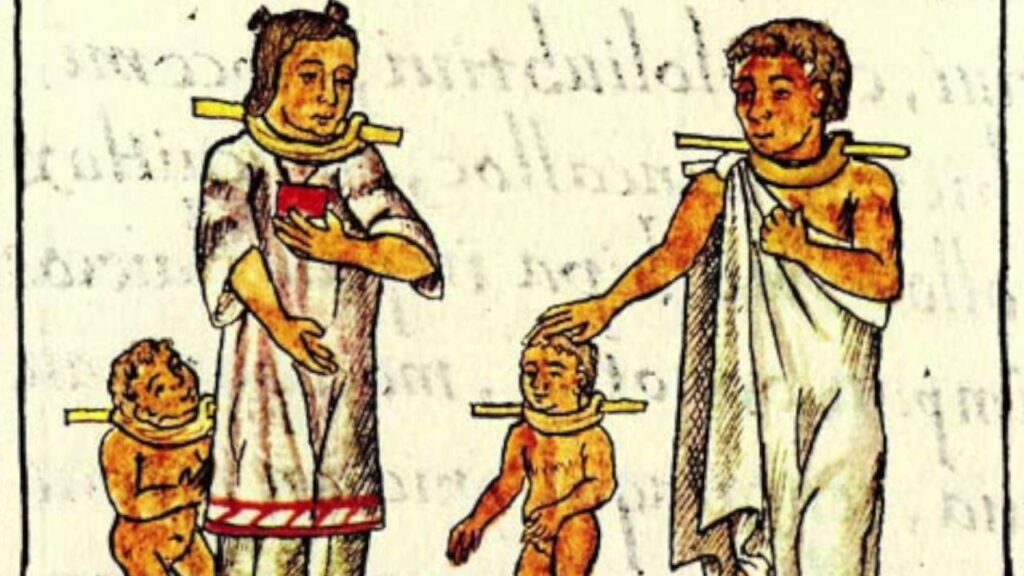
Unlike chattel slavery systems, Aztec slavery was not hereditary. Children born to enslaved persons were born free. Individuals became enslaved through several circumstances: criminal conviction for theft or other offenses; inability to repay debts; or voluntary servitude during periods of economic hardship. This flexibility meant slavery served different economic functions and could be temporary for some individuals.
Legal Rights and Social Status of Enslaved Persons
Aztec slavery granted enslaved persons legal rights uncommon in other historical systems. Enslaved individuals could marry, own property, and even own slaves themselves. This created a stratified system where enslaved status did not preclude economic participation. Unlike forced labor systems, Aztec enslaved persons typically worked as domestic servants in noble households while retaining time and resources for personal pursuits, including agriculture or craftwork. Many enslaved persons accumulated sufficient resources to purchase their own freedom or transition to free status through other means.

Legal Protections and Limits on Master Authority
Aztec law imposed specific obligations on slave owners. Masters were legally required to provide food, clothing, and shelter. Importantly, a master could not arbitrarily sell or harm an enslaved person. If a master wished to sell an enslaved person, he had to present evidence of misbehavior before witnesses in a public marketplace, establishing legal grounds for the sale. This requirement created accountability and prevented casual abuse or exploitation. These protections represented a significant legal distinction from slavery systems based on absolute master authority.
Slavery as Legal Punishment and Debt Resolution
Criminal offenses and unpaid debts could result in enslavement. Slavery functioned as an alternative to execution or other severe punishments. Debt slavery was intended as temporary: enslaved persons could theoretically regain freedom once debts were repaid. However, the conditions of servitude, work requirements, and debt structure meant many enslaved persons remained trapped in servitude for extended periods or entire lifespans.
The risks of being a master (it wasn’t all plain sailing!)

Owning a slave was not always a bargain. If your slave escaped and made it to the palace, you lost all rights to him. And if you tried to interfere with his escape and got caught… surprise: now you were the slave! So masters had to think twice before misbehaving with their servants.
Unexpected rights and opportunities
The Aztec system had a sporting touch: if you were tired of being a slave and wanted to risk it all, you could try that famous escape to the palace. But if you preferred a more conventional approach, you could also save up to buy your freedom. Also, no one could sell you without your consent (yes, you read that right), which gave you some control over your destiny.
The Gap Between Law and Enforcement During Crisis
The legal protections afforded to enslaved persons were most fragile during periods of social or economic crisis. During famines, droughts, and periods of instability, enforcement of slavery laws weakened significantly. Enslaved persons, already vulnerable, suffered disproportionately during these times. Masters facing economic desperation were more likely to ignore legal protections and exploit enslaved labor beyond normal bounds. Additionally, a vengeful master could pursue an escaped slave with minimal fear of legal consequence, particularly if the escape occurred during chaotic times. The law provided theoretical protection, but during crises—when enslaved people needed protection most—those safeguards often failed.
Sacrifice and Violence: The Darkest Realities
Enslaved persons, particularly prisoners of war and those deemed rebellious, were sacrificed during Aztec religious ceremonies. Sacrifice was integrated into Aztec spiritual practice, and enslaved individuals were considered suitable offerings to the gods. This represented one of the most brutal aspects of enslavement in Aztec society—enslaved people had no protection from ritual sacrifice during religious events or ceremonies.
Beyond sacrifice, enslaved persons faced constant vulnerability to violence and abuse. While law theoretically protected them from mistreatment, enforcement was inconsistent. Sexual violence against enslaved persons occurred, particularly enslaved women. Masters could inflict punishment for perceived disobedience, and the legal recourse available to enslaved persons was often ineffective in preventing abuse. The combination of legal vulnerability, economic desperation, and social powerlessness created conditions where enslaved persons had limited ability to protect themselves from exploitation and violence.
Aztec Slavery: A Complex System
Aztec slavery differed significantly from later European chattel slavery. Enslaved persons had legal rights, opportunities for freedom, and could own property. However, these protections were fragile. During famines, crises, and social upheaval, legal safeguards weakened dramatically. Enslaved persons remained vulnerable to exploitation, violence, sacrifice, and revenge. Slavery was a system of control that, despite certain legal protections, fundamentally deprived people of freedom and safety. Understanding this complexity—both the rights granted and the brutal realities—provides a complete historical picture.

FAQs About Aztecs Slavery
Sources:
- World History Encyclopedia
- Wikipedia and HistoryCrunch.com
- Academic research on Aztec law and slavery
- Historical codices and archaeological evidence
- Scholarly studies on Aztec social systems